


What is antifreeze made of?
Summary
The challenge of the cold and the science of protection
Water and ice
In the realm of industrial maintenance, water remains the premier heat-transfer fluid due to its high thermal capacity and availability. However, it possesses an insurmountable physical limitation: a freezing point of 0°C. When water freezes—undergoing a change of state—it expands in volume by approximately 9% due to the formation of a hexagonal crystalline lattice. Within a closed circuit, such as an industrial chiller or a heating system, this expansion can be destructive. The force exerted by the ice can generate internal pressures exceeding 2,500 bar—sufficient to rupture steel piping, heat exchangers, and cast-iron engine blocks.

Freezing-point depression
The solution to this problem is not mechanical, but chemical. Antifreeze works by exploiting the colligative properties of solutions. Dissolving a specific solute in the aqueous solvent interferes with the molecules' ability to organize into ordered ice crystals. This phenomenon, known as freezing-point depression, allows the mixture to remain liquid at temperatures well below zero. It is important to note that the relationship is not linear: there is a "eutectic" point—a specific concentration at which the mixture reaches the lowest possible freezing point (often below -50°C)—beyond which adding more antifreeze becomes counterproductive.
Analysis of an antifreeze
Behind the question "what is antifreeze made of?" lies a complex chemical engineering process. A modern fluid is a balanced mixture of anti-corrosion and anti-freeze components designed for long-lasting performance.
So, what is antifreeze made of?
Antifreeze is primarily composed of glycols; these substances act as molecular disruptors by inserting themselves between water molecules, thereby hindering the formation of the hydrogen bonds required to create the ordered crystalline lattice of ice. This increase in entropy (disorder) prevents solidification at 0°C, requiring more energy from the system—and thus much lower temperatures—for the microscopic structure to stably organize into a solid macroscopic form.
There are two main types used in the industry:
Ethylene Glycol: This is the standard for heavy-duty industrial and automotive applications. It offers superior heat exchange efficiency and low viscosity, making it ideal for systems requiring high cooling performance.
Propylene Glycol: Distinguished by its non-toxicity, this is the required choice for the food and pharmaceutical sectors, as well as for civil installations where the risk of accidental contact with potable water or the environment necessitates a high safety profile.

Inhibitor additives
Glycol provides frost protection, but it is the inhibitors that protect the metal. Without them, the water-glycol mixture would become aggressive, triggering widespread galvanic corrosion throughout the system.
Traditional technology: Based on inorganic salts. They create a physical protective layer on surfaces but tend to degrade quickly and can reduce heat transfer.
Organic technology: The basis of modern "Long Life" formulations. It uses organic acids that react chemically only at points where corrosion is likely to start (anodic sites). This creates a monomolecular protective film that does not hinder heat transfer and lasts much longer, avoiding issues with salt precipitation.
Fiprokim solutions
Fiprokim has distilled this technology into the FIPRO MAT line, offering solutions tailored to diverse system requirements, backed by a systemic approach to maintenance.
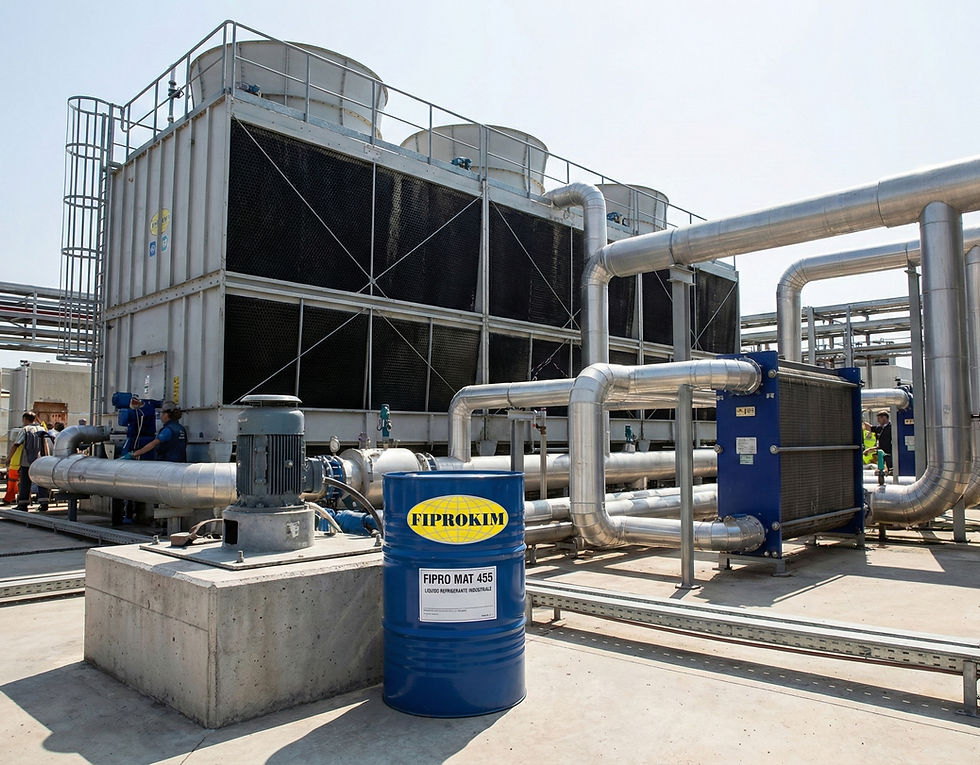
These are the main products in the FIPRO MAT line:
FIPRO MAT 455: industrial-grade performance
FIPRO MAT 455 is the benchmark fluid for applications requiring maximum thermal efficiency and protection.
Base: Concentrated ethylene glycol.
Technology: Fully organic and free from nitrites, amines, and phosphates. This formulation prevents the formation of solid deposits and ensures exceptional stability, even at high temperatures.
Applications: Ideal for engine cooling circuits, industrial chillers, and refrigeration systems where the priority is preventing corrosion (including cavitation) and maintaining optimal heat exchange.
FIPRO MAT 457: ecological safety
FIPRO MAT 457 represents a sustainable and safe choice for sensitive environments.
Base: Non-toxic propylene glycol.
Green Profile: Being propylene-based, it is not classified as harmful to human health, making it suitable for the food and pharmaceutical industries as well as civil installations (such as solar panels and heat pumps) where environmental safety is a priority.
Performance: It maintains excellent anti-corrosion and anti-scaling properties—protecting copper, aluminum, and steel—while ensuring complete biodegradability and safety in use.
Synergy with FIPRO AK: the complete treatment
Introducing antifreeze into a system should never be done without proper preparation. A dirty system will rapidly degrade even the best antifreeze. This is where the synergy with the FIPRO AK line comes into play. Whether prior to filling with FIPRO MAT or as part of ongoing maintenance, FIPRO AK products are essential for preventing the formation of inorganic deposits that thermally insulate surfaces. The combined use of FIPRO MAT (455 or 457) and FIPRO AK treatments ensures not only frost protection but also the energy efficiency and longevity of the entire system.


